AI is the most significant productivity multiplier freelance game designers have access to right now. The question of why freelance game design needs AI comes down to one simple reality: solo developers cannot compete with studio teams on raw output unless they use tools that multiply their capacity. AI in game design compresses timelines, handles repetitive execution tasks, and opens creative possibilities that were previously locked behind team budgets. The result is a new kind of freelance developer who ships more, burns out less, and focuses energy where it matters most.
How does AI improve efficiency for freelance game designers?
AI tools save freelance developers 20–35 hours weekly by automating boilerplate coding, asset placement, and documentation. That is the equivalent of hiring a part-time assistant without the payroll cost. For a solo developer juggling design, code, art, and marketing, that time recovery is the difference between shipping a game and abandoning it.
The efficiency gains show up in three specific areas:
- Boilerplate code generation. AI tools like GitHub Copilot and Cursor write repetitive code structures in seconds. A freelancer no longer spends an afternoon setting up collision detection or inventory systems from scratch.
- Asset generation and placement. Tools like Midjourney, Leonardo AI, and Stable Diffusion produce concept art, texture variations, and UI mockups rapidly. Developers without formal art training can now build visually coherent prototypes.
- Documentation and project management. AI drafts design documents, changelogs, and bug reports. This keeps projects organized without pulling the developer away from actual building.
The freelance game development benefits extend beyond raw time savings. A 2026 survey of 2,000 freelancers found that 95% reported improved quality of life after going independent, with 64% citing higher income and project autonomy as the primary drivers. AI amplifies both. Higher output means more completed projects. More completed projects mean more income and a stronger portfolio.
Pro Tip: Treat AI as your virtual assistant for execution tasks. You set the creative direction. AI handles the scaffolding. This mental model prevents over-reliance and keeps your judgment in charge.

What creative tasks can AI augment vs. what must stay human?
AI accelerates prototyping and mechanic generation, but it cannot replicate human taste. This is the most important distinction freelance designers need to understand. AI will generate five level layouts in the time it takes you to sketch one. It will not tell you which one feels fun to play.
The creative division of labor works like this. AI handles generation. You handle judgment.
| Creative Task | AI Strength | Human Strength |
|---|---|---|
| Mechanic ideation | Generates many options fast | Selects what fits the game’s feel |
| Dialogue drafting | Produces volume quickly | Edits for voice, tone, and pacing |
| Level layout | Creates structural variety | Judges flow, tension, and player experience |
| Playtesting feedback | Runs automated test passes | Interprets emotional player response |
| Visual style direction | Generates reference variations | Curates coherent aesthetic identity |
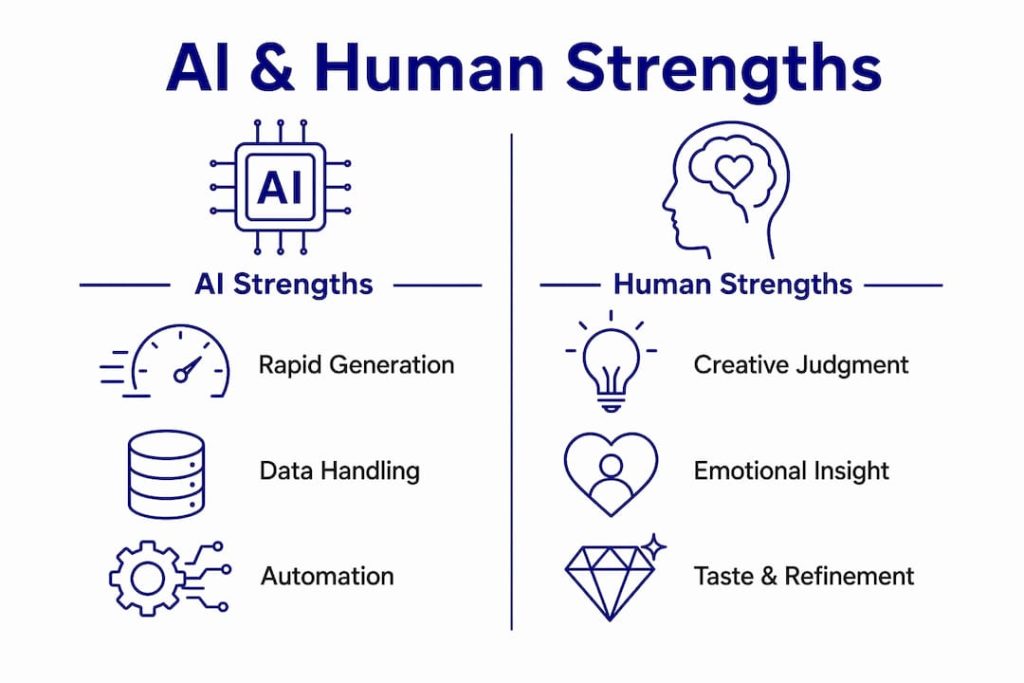
Successful designers use AI for rapid iteration while keeping final creative decisions entirely human. The role of AI in game dev automation is best understood as a junior designer on your team. A junior designer can draft ideas, run errands, and fill in gaps. They cannot replace the senior designer’s vision or taste.
Where freelancers get into trouble is when they accept AI output without critical review. AI-generated dialogue often sounds flat. AI-generated levels often feel arbitrary. The designer’s job is to recognize the difference between a technically correct output and a genuinely good one.
Pro Tip: After every AI generation pass, ask yourself one question: “Does this feel right?” If you hesitate, revise it. Your instinct is the quality filter AI does not have.
How does AI transform solo game development possibilities?
AI enables solo developers to compress production timelines from years to months for complex games that were previously impossible to build alone. A multi-level game with boss fights, dialogue trees, and a coherent art style used to require a team of five or more people working for two years. In 2026, a focused solo developer using AI tools can ship a comparable product in six to nine months.
The shift is not just about speed. It is about what becomes possible at all.
“The biggest bottleneck now is judgment and scope rather than build capability. AI expands what freelancers can attempt creatively.” — Summer Engine, 2026
This changes the freelancer’s core challenge. Before AI, the question was “Can I build this?” Now the question is “Should I build this?” That is a fundamentally better problem to have. It means your creative ambition is no longer capped by your technical bandwidth.
The impact of AI on gaming also reshapes how freelancers manage scope and avoid burnout. AI handles the tasks that drain energy without building skills. Writing the same collision handler for the fifth time teaches nothing. Having AI write it while you focus on game feel teaches you what matters.
Freelance developers who integrate AI into their workflows gain specific, measurable advantages:
- Faster prototyping. Test five mechanics in the time it previously took to build one.
- Reduced cognitive load. AI manages documentation and repetitive code, freeing mental energy for design decisions.
- Better work-life balance. Time savings translate directly to fewer late nights and more sustainable output.
- Expanded project scope. Solo developers can now attempt genres that previously required team collaboration.
- Deeper creative focus. With execution handled, designers spend more time on the decisions that define a game’s identity.
AI also suits the working style of many freelancers, particularly those who thrive in deep focus environments with asynchronous communication. The AI-assisted workflow rewards concentration and independent thinking, which are exactly the strengths that draw many developers to freelance work in the first place.
What strategies help freelancers integrate AI without losing control?
The most common mistake freelancers make with AI is treating it as a one-shot solution. You do not describe your entire game to an AI and receive a finished product. You use AI iteratively, one task at a time, with human review at every step.
Here is a practical integration framework:
- Start with prototyping, not production. Use AI to test mechanics and layouts before committing to full builds. This prevents wasted effort on ideas that do not work.
- Use a multi-agent approach for complex projects. Multi-agent AI systems with an orchestrator managing specialized executors maintain project context better than a single AI session. This reduces bugs caused by context window overflow and keeps outputs consistent.
- Set scope limits before you start. AI makes it easy to add features. That ease creates scope creep. Define what the game is before you use AI to build it.
- Playtest constantly. AI cannot judge fun. You can. Build short playtest loops into your workflow so human feedback shapes every iteration.
- Keep a design document current. AI works best when it has clear context. A living design document gives AI the reference it needs to produce consistent, on-brand outputs.
The LLM-assisted game development workflow developed by practitioners in 2026 treats AI as a capable executor, not a creative director. The freelancer sets the vision, breaks it into discrete tasks, assigns those tasks to AI, and reviews every output before it enters the project. This keeps quality high and creative identity intact.
Pro Tip: Never let AI make two consecutive decisions without a human review in between. Chained AI decisions compound errors and drift from your original vision faster than you expect.
Key takeaways
Freelance game design needs AI because it multiplies solo developer capacity without replacing the human judgment that makes games worth playing.
| Point | Details |
|---|---|
| AI saves significant time | Automating boilerplate code and asset tasks saves developers 20–35 hours weekly. |
| Creative judgment stays human | AI generates options; designers select, refine, and decide what feels right. |
| Timelines compress dramatically | Solo developers can now ship complex, multi-level games in months rather than years. |
| Multi-agent workflows reduce errors | Using orchestrator and executor AI agents maintains context and improves output quality. |
| Scope discipline is non-negotiable | AI makes adding features easy, so freelancers must define project limits before building. |
The freelancer as director, not executor
I have spent enough time watching developers burn out chasing AI-generated scope to say this plainly: the tool is not the problem. The mindset is.
When I first started integrating AI into game design workflows, the temptation was to let it run. Generate the level. Generate the dialogue. Generate the enemy behavior. The output looked impressive in isolation. But when I played the result, it felt like nothing. Technically functional, creatively empty.
The shift that actually worked was treating myself as a film director, not a laborer. A director does not build the set. They decide what the set communicates. AI builds the set. You decide if it communicates what the game needs.
The freelancers I see succeeding in 2026 are not the ones using the most AI tools. They are the ones who use AI for a narrow, well-defined set of tasks and stay deeply involved in everything else. They prototype fast, playtest constantly, and kill ideas ruthlessly. AI gives them the speed to do that without the exhaustion.
The risk I see most often is scope inflation. AI makes it easy to say yes to features. A solo developer who previously knew their limits now has a tool that removes those limits temporarily. The game grows. The vision blurs. The project stalls. Discipline around scope is now a more important skill than it has ever been.
My honest advice: use AI to do more of what you already do well, not to attempt everything at once. Your creative identity is the product. Protect it.
— Adrian
How Gamedevaihub supports ai-powered freelance developers
Freelance game designers who want to use AI effectively need more than a list of tools. They need tested workflows, honest comparisons, and a community that understands the solo development reality.
Gamedevaihub is built specifically for indie and freelance developers who want to integrate AI into their game development process without losing creative control. The platform offers practical guides, prompt libraries, and tool comparisons tested in real 2026 development environments. Whether you need help generating art without formal training or building a faster prototyping loop, Gamedevaihub gives you the resources to move faster and ship better. Start with the tool guides and find the workflow that fits your project.
FAQ
How much time can AI save a freelance game designer?
AI tools save freelance developers an estimated 20–35 hours weekly by automating boilerplate coding, asset placement, and documentation tasks. That time recovery is equivalent to adding a part-time assistant to your workflow.
Can AI replace human creativity in game design?
AI cannot replace human creativity in game design. It generates options quickly but lacks the ability to judge pacing, fun, or emotional resonance, which are decisions that require a human designer.
What is the best way to start using AI in a solo game dev workflow?
Start with iterative prototyping rather than full production. Use AI to test mechanics and layouts first, review every output before it enters your project, and keep a current design document to give AI consistent context.
Does AI help freelancers manage scope and avoid burnout?
AI reduces cognitive load by handling repetitive tasks, which frees mental energy for design decisions. The risk is scope creep, since AI makes adding features easy, so setting firm project limits before building is critical.
What are multi-agent AI systems and why do they matter for game dev?
Multi-agent AI systems use an orchestrator to manage specialized executor agents, maintaining project context across complex tasks. This approach reduces bugs from context overflow and produces more consistent outputs in longer development sessions.