by
by Players punish the AI they catch.
We analysed 352,296 Steam reviews. On games caught using AI, 79% of reviews that mention it are negative. On games where AI is the selling point, it’s 26%, about the same as the rest of their reviews. Art and store images draw the fire. Code shows up in 2.4% of complaints. Below are five real cases and a ladder for using AI without paying for it.
The short answer#
Yes, sometimes. Visible AI is the trigger. If a player can see it or hear it, they will judge it. That means your capsule art, your cutscenes, your voices and your in-game art.
Hidden AI mostly isn’t a problem, because players don’t review your code or your build pipeline.
Rule of thumb: if it ships where a player can see it, disclose it before someone finds it.
What the sales data says#
You’ve probably seen the claim that AI cuts sales by 53%. It comes from a Game Oracle analysis published in December 2025.
The study looked at 9,879 paid Steam games released between January and October 2025. Games with an AI disclosure got an estimated 52.6% fewer reviews in their first month than comparable games without one. Game Oracle used reviews as a stand-in for sales, so it’s a review count, not revenue.
It’s also a correlation. The author says the results “could still be biased” because marketing, skill and budget are hard to measure. And the effect wasn’t even. For low-quality games, AI “makes no difference.” The penalty showed up for high-potential games from experienced developers.
So the better your game, the more AI can cost you.
Two other datasets point the same way:
- Sulka Haro counted 53,597 Steam games released between July 2023 and July 2026. About one in three new releases now discloses AI. Those games reach 100 reviews at 55% of the rate of games without AI. That gap hasn’t closed in two years.
- A peer-reviewed study by Bazzaz and Cooper at Northeastern analysed 508,192 Steam reviews. AI-disclosed games were recommended 68.4% of the time. Games tagged procedural generation got 86.3%.
GameDiscoverCo’s numbers point the other way. It surveyed about 3,800 Steam fans in July 2026. Only 8% said they just won’t buy a game with AI. 43% said they have no big issue with it.
So most players won’t boycott you. But the ones who care write reviews, and reviews are what the next buyer reads.
What 352,296 Steam reviews told us#
Surveys tell you what players say, but reviews show what they do, so we built our own dataset.
We pulled English reviews for 49 games. Some had a documented AI controversy, some were built around AI, and some were popular games with no AI at all. We added 246,338 Reddit comments from threads about AI in games and 32,285 YouTube comments. That’s 284,462 comments in total.
Then we flagged the ones that talk about generative AI. We hand-checked a random sample of 371 to make sure the filter worked. Between 97.7% and 99.3% were correct, depending on the platform.
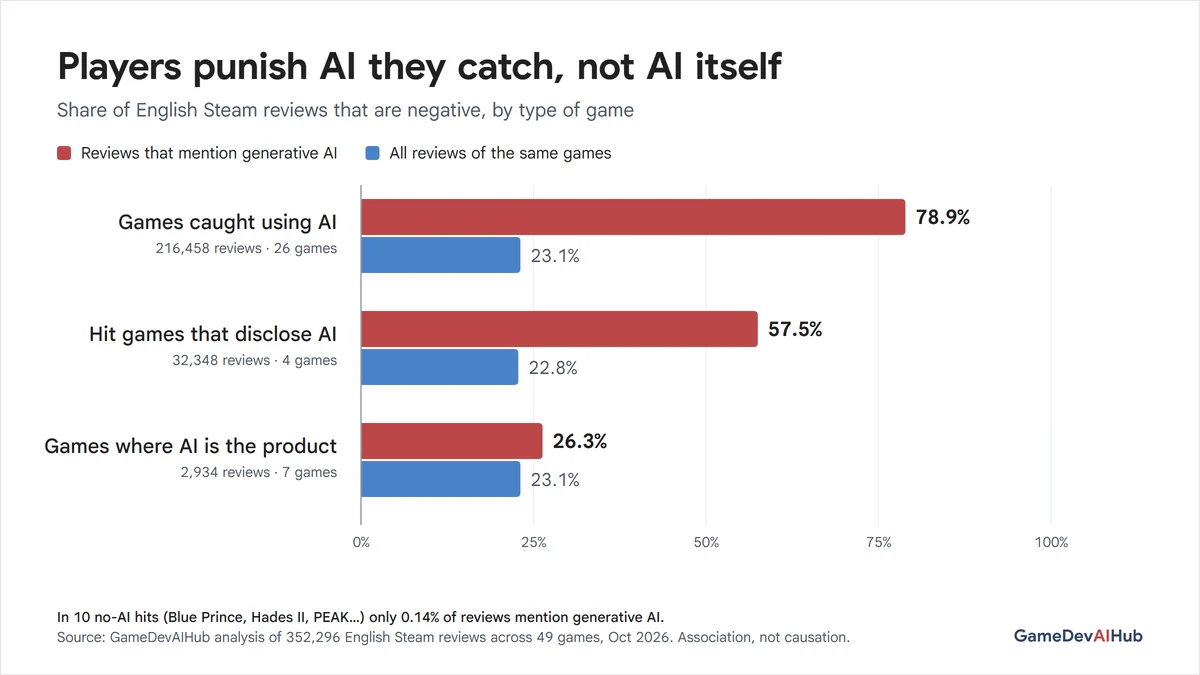
On games caught using AI, 78.9% of reviews that mention it are negative. Across all reviews of those same games, 23.1% are negative. That’s 3.4 times the normal rate.
When AI is the product, players judge the game instead. Games like AI Roguelite, AI2U and Whispers from the Star are built on AI. On those games, reviews that mention AI are 26.3% negative. Across all their reviews it’s 23.1%, close enough to call even.
Games with no AI almost never get AI reviews. Across 99,986 reviews of hits like Blue Prince, Hades II and PEAK, only 0.14% mention generative AI. That’s about one review in 700.
AI complaints also carry more weight. Negative reviews that mention AI earned a median of 4 “helpful” votes. Other negative reviews earned 1. Steam shows the most helpful reviews by default, so AI complaints are more likely to sit where the next buyer looks.
Most critics still play. Players who complain about AI wrote their review after a median of 11.3 hours of play. Only 18% wrote it inside Steam’s 2-hour refund window. And in Steam reviews, “wait for a sale” comes up almost as often as “I quit” (135 mentions against 160).
So the typical punishment is a thumbs-down that warns the next buyer. Only 3.2% of these negative reviews carry Steam’s refunded flag.
Case studies#
In each of these four stories, what mattered was when players found the AI and what the studio did next.
James Pond Legacy. Players spotted AI-looking art in the trailer and character work. The original creator, Chris Sorrell, said he hoped they “choke on an AI-generated fishbone.” Publisher System 3 denied using generative AI, blamed its developer’s assurances, and changed a caption from “3D Algorithm” to “3D Render.” Its boss Mark Cale admitted the controversy “has damaged confidence in System 3.” (Time Extension)
Vapor World: Over The Mind. The director swapped two cutscenes for AI video just before launch. Players noticed on day one. He posted an apology on Steam: “Using AI was entirely my own fault, and I am sorry.” The same day, a hotfix removed every AI cutscene. Its Steam rating sits at Mixed, and AI comes up in 48% of its English reviews.
Larian. In December 2025, CEO Swen Vincke said Larian used AI to explore ideas and write placeholder text for its next Divinity game. On 17 December, 22.5% of the Baldur’s Gate 3 reviews in our sample mentioned AI. Within weeks he reversed course and said “there is not going to be any GenAI art in Divinity.” (VGC) BG3 stayed overwhelmingly positive.
Sandfall and Clair Obscur: Expedition 33. AI placeholder textures slipped into the released game. Director Guillaume Broche said they were taken out “as soon as we saw it” and promised “everything will be made by humans from us” (Push Square).
The bigger problem was what Sandfall had said earlier. It had told the Indie Game Awards no generative AI was used, so when the placeholders came out, the awards withdrew its Debut Game and Game of the Year wins. AI mentions in its reviews peaked at 12% of our daily sample, then dropped back under 3% within about ten days. The game still sold more than 8 million copies.
| Game | What players spotted | Outcome | What the studio did |
|---|---|---|---|
| James Pond Legacy | AI-looking trailer and character art | Public anger from the series creator, trust damage | Denied, blamed the developer, changed a caption |
| Vapor World | AI video in two cutscenes | Mixed reviews, AI named in 48% of them | Apologised, removed the cutscenes on launch day |
| Larian (Divinity) | AI for concepts and placeholder text | BG3 review spike, 22.5% AI mentions on one day | Banned gen AI art from Divinity |
| Clair Obscur | AI placeholder textures that shipped | Indie Game Awards withdrawn, 8M+ sold | Confirmed the placeholders, removed them |
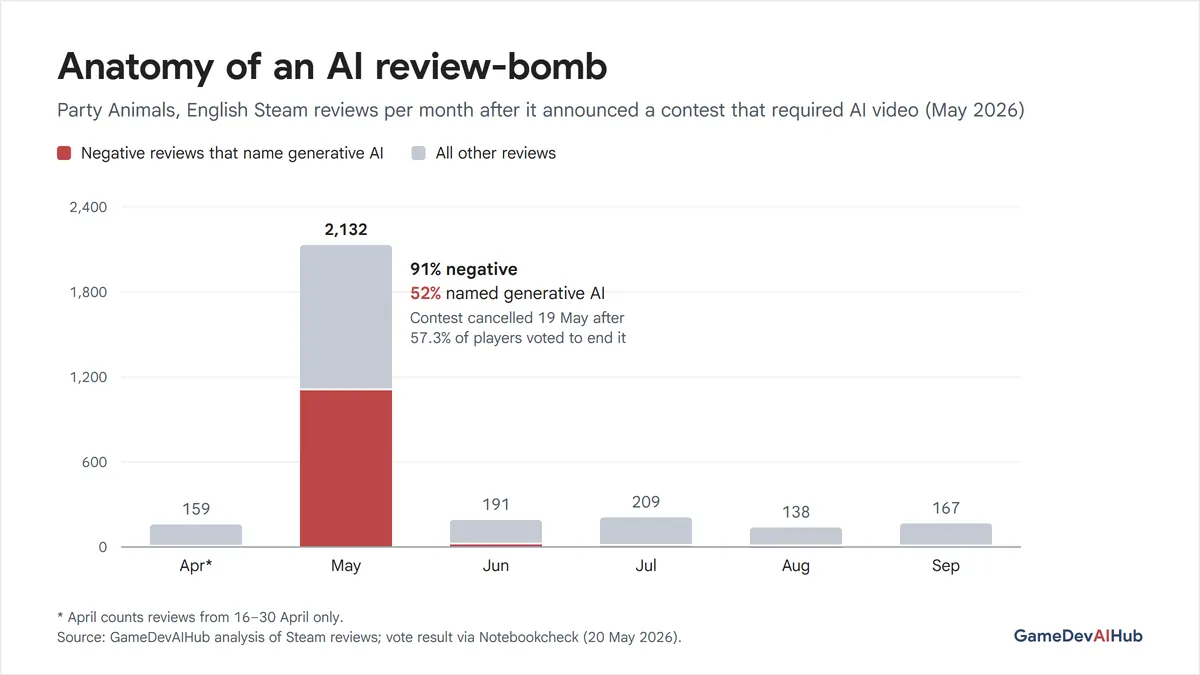
Party Animals shows how bad it can get. In May 2026, its developer announced a contest that required AI video. In our data, the game’s English reviews jumped from 159 in the second half of April to 2,132 in May. Of those, 91% were negative and 52% named AI. The developer cancelled the contest after 57.3% of players voted to end it.
Big games survive this. ARC Raiders used text-to-speech voices and sold 14 million copies. Crimson Desert’s own Steam page says it used generative AI for some 2D props, and it sold 2 million in a day. An indie launch has no cushion like that.
What players object to and what they ignore#
Players object to the AI they can see.
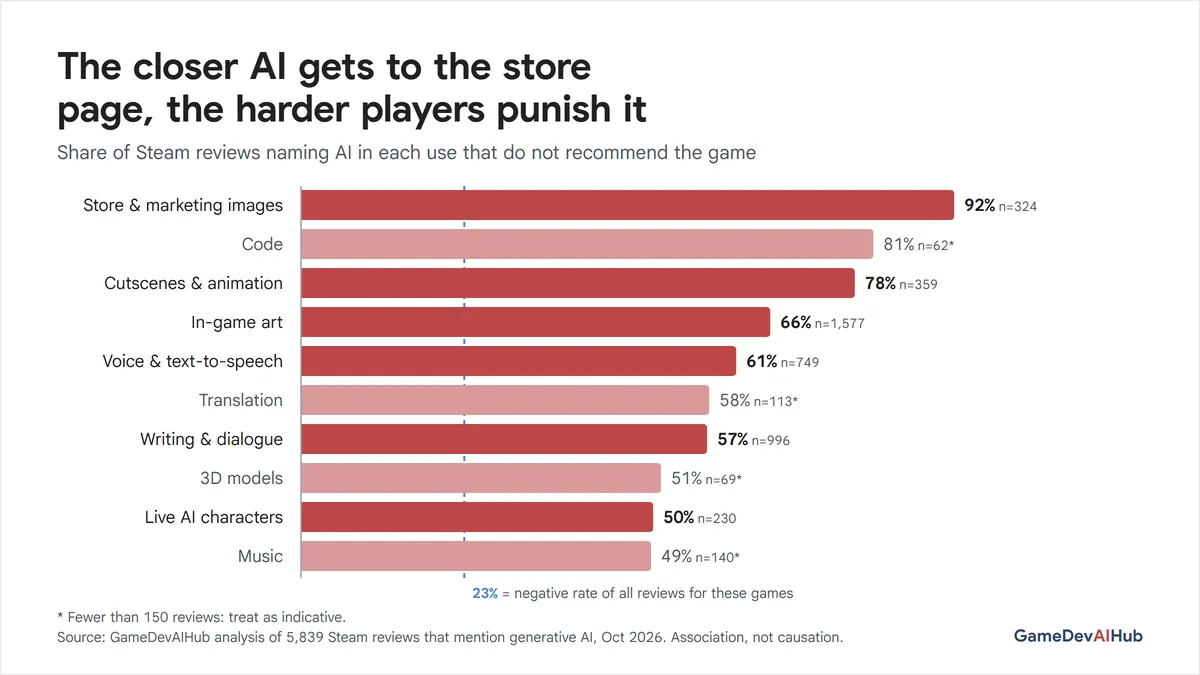
Among negative Steam reviews that mention AI and name what it was used for, visual art comes up in 49.1%. Writing and text appear in 26.8%, voice in 21.6%. Code appears in 2.4%.
The riskiest place for AI is your store page. When a review names AI in store or marketing images, 92% are thumbs-down. Cutscenes come in at 78% and in-game art at 66%.
| Draws fire | Mixed reaction | Rarely mentioned |
|---|---|---|
| Store and capsule art (92% negative when named) | Writing and dialogue (57%) | Code (2.4% of AI complaints) |
| Cutscenes and animation (78%) | Voice and TTS (61%) | Translation (3.1% of AI complaints) |
| In-game art, portraits, cosmetics (66%) | Music (49%, few mentions) | Tools and testing (players can’t see them) |
Surveys agree. Quantic Foundry found gamers most negative about AI artwork, music and dialogue, and least negative about AI for dynamic difficulty. In GameDiscoverCo’s survey, coding tools were the most accepted use.
Players also told us how they catch it. The most cited clue in our data is the disclosure label itself, with 4,019 mentions. Then hands and fingers (2,938) and that glossy “AI look” (1,092). So if you use AI where players look, assume someone will check.
Is AI placeholder art okay?#
Both sides of this argument have a point.
The case for it is simple. A placeholder lets you test a level before you pay an artist. And players in GameDiscoverCo’s survey named prototyping and placeholders as the second most acceptable use of AI.
The case against it is that placeholders do ship. Clair Obscur proves it. And on The Alters, where AI text was found before it was disclosed, 69% of reviews that mention AI are negative. The game’s normal rate is 11%.
Our rule:
- Mark every placeholder in the build itself. A visible “TEMP” stamp works.
- Keep a list of every AI asset and who will replace it.
- Never put a placeholder on your store page, trailer or capsule.
- Check the list before launch. Disclose anything that stays.
If you need art you can actually ship, start with our guide to AI pixel art generators for 2D indie games and read the licence terms before you commit.
What you must disclose#
Steam. Valve’s content survey covers AI content that “ships with your game, and is consumed by players,” like artwork, sound, narrative and localization. The current Steamworks text says “efficiency gains through the use of these tools is not the focus.” So code assistants don’t need a label. Content generated live while the game runs needs a description of your guardrails. Players see your answer in an “AI Generated Content Disclosure” box on the store page.
Our Steam AI disclosure guide covers what to declare and what the label costs you.
itch.io. Since November 2024, every project page has a generative AI disclosure field. Answer yes and your page gets the AI Generated tag, plus sub-tags for graphics, sound, text and code. Answer no and you get the No AI tag. It’s mandatory for asset pages. Untagged AI assets drop out of browse.
Some devs use the disclosure box to say what they didn’t use, and you should copy them. AI2U’s Steam disclosure reads “None of the art assets in the game are AI-generated.” Only 17% of Steam fans believe developers fully disclose, so saying it plainly helps.
Game jam AI rules#
Jams don’t agree, so read the rules page every time. Most fall into one of three types.
| Policy type | Example jam | What the rules say |
|---|---|---|
| Full ban | Godot Wild Jam | “No vibe code, no AI-generated art, no AI-composed music, no AI-written dialogue, no AI assets of any kind.” |
| Code only (no AI assets) | GMTK Game Jam | “Your game must not use AI generated art or audio assets,” including the itch.io thumbnail |
| Allowed with disclosure | Ludum Dare | AI tools are allowed, but “you should opt-out of categories where a content generation tool did most of the work” |
Global Game Jam goes further and allows AI with no restrictions. Its own survey of 3,578 jammers found 18% of teams used AI.
What if you’re falsely accused of using AI?#
It happens, and it costs real studios. Shrine’s Legacy was review-bombed as “100% AI generated.” The team said they “only worked with real human artists on everything,” and the reviews recovered (Vice). The team behind Schrodinger’s Cat Burglar changed its capsule art because people kept calling it AI. It wasn’t. Axion 1986 says it lost press coverage over a trailer it made by hand (Creative Bloq).
You can’t stop the accusation, but you can make proof easy. Keep this ready before launch.
- Layered source files: PSD, Krita or Blender files with their history.
- A timelapse. Record your screen while you paint. The Little Droid team answered its accusers with a video showing the art being made.
- Dated sketches, thumbnails and roughs.
- A public devlog with work-in-progress images, posted as you go. Dates on the internet are hard to fake.
- Credits that name your artists and link their portfolios.
- Your AI policy on the store page, with a way for people to ask.
A safe-use framework#
Use this ladder from safest to riskiest. Each step up raises the chance that players notice and care.
- Code, QA and tools. 2.4% of AI complaints. Steam doesn’t ask about it. See our list of free AI tools for indie game developers.
- Placeholders that never ship. Accepted by many players, if you follow the rule above.
- Translation. Named in 3.1% of AI complaints, but Steam does require disclosure.
- Writing and dialogue. Named in 26.8% of AI complaints.
- Voice. Named in 21.6%. ARC Raiders survived it, and its CEO still said “a real professional actor is better than AI” (Engadget).
- In-game art. Named in 49.1%, the biggest single target.
- Cutscenes and store art. 78% and 92% negative when named. Vapor World pulled its AI cutscenes on launch day.
The higher you go, the more you need disclosure, a plan to replace, and proof. For the full tool list, see our best AI tools for indie game developers.
FAQ#
Will AI art hurt my game sales?#
It can. Game Oracle estimated 52.6% fewer first-month reviews for AI-disclosed games, and Sulka Haro found they reach 100 reviews at 55% of the normal rate. Both are correlations. Visible AI art is where the risk sits.
Do gamers hate AI games?#
Many do. Quantic Foundry found 85% of 1,799 core gamers rate gen AI below neutral. But only 8% of Steam fans told GameDiscoverCo they won’t buy a game with AI. In our data, games built around AI get normal reviews.
Is AI placeholder art okay in an indie game?#
Yes, if it never ships. Mark it in the build, track it, keep it off your store page, and replace it before launch.
Do I have to disclose AI code on Steam?#
No. Steam’s survey targets content players consume, like art, sound, narrative and localization. Efficiency tools aren’t the focus.
What does the itch.io No AI tag mean?#
It’s added automatically when you answer no in the generative AI disclosure field on your project page.
What should I do if I’m falsely accused of using AI?#
Show your process. Layered files, timelapses, sketches and a devlog are the fastest proof. Post a clear AI policy on your store page.
How we did this research#
We collected public comments on 5 and 6 October 2026 from Steam’s public review API, the Arctic Shift Reddit archive and 48 YouTube videos about AI in games. We flagged generative AI mentions with transparent keyword rules and hand-checked a random sample of 371. Every number here shows an association, not a cause. Commenters chose to write, so this isn’t a random sample of all gamers.
How we use AI on this site: We used Claude to write the collection scripts and to help sort and check the comments. Every statistic in this article was checked against its original source before publishing.